
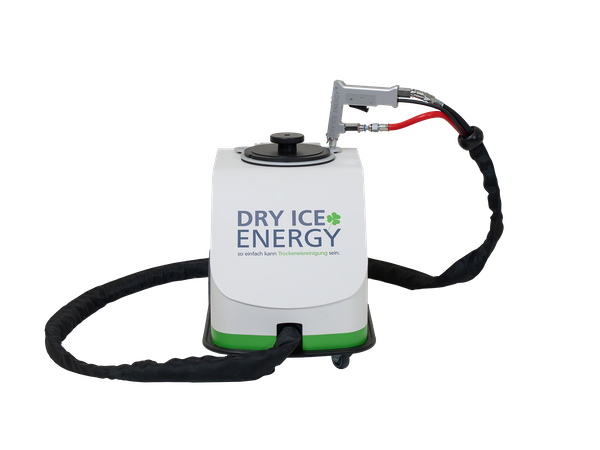
Champ Turbo
Powerful dry ice blaster for detailed car work and moderate industrial cleaning tasks.
1. Before You Start
Make sure you have everything ready before powering on the machine.
| Requirement | Details |
|---|---|
| Compressor | 17.7–49.4 CFM at 120–180 PSI |
| Air Connection | 1/2" quick-connect coupling |
| Dry Ice | 1.5–3 mm micro-pellets (rice pellets) Use within 24–48 hours of purchase for best results |
| Water Separator | Mandatory if air is humid — moist air freezes instantly on contact with dry ice, clumping pellets and clogging the machine Install an inline water separator / condensator between the compressor and the machine |
| Safety Gear | Safety glasses, hearing protection, insulated gloves |
| Ventilation | Well-ventilated area or outdoors (CO₂ displaces oxygen) |
2. Safety
Dry ice blasting is safe when you follow these rules.
Ventilate Your Workspace
Dry ice sublimates into CO₂ gas, which displaces oxygen. Always work outdoors or in a well-ventilated area. Never blast in a sealed room.
Never Aim at People or Animals
Sub-zero pellets at high velocity cause severe frostbite and physical injury. Treat the blasting gun like a power tool — point it only at work surfaces.
Wear Your PPE
Safety glasses protect against debris. Hearing protection is essential — compressed air is loud. Insulated gloves prevent frostbite when handling dry ice.
Handle Dry Ice Safely
Never touch dry ice with bare hands. Store it in an insulated container (never airtight). Transport in a ventilated vehicle.
3. Setup & Operation
Three steps from unboxing to blasting.
Load Dry Ice
Open the hopper lid and fill with dry ice pellets (1.5–3 mm). Wear insulated gloves — pellets are at −109.3 °F.
Connect Compressed Air
Attach your air hose via the 1/2" quick-connect fitting. Ensure the air supply is dry and oil-free — moisture causes ice blockages inside the machine. In humid conditions, always use a water separator between the compressor and the machine.
Start Blasting
Aim the nozzle at the surface, squeeze the trigger, and let the dry ice do the work. The machine delivers a consistent stream. Adjust your distance from the surface to control cleaning intensity. Start from 12–18 inches away and move closer as needed.
4. How Dry Ice Blasting Works
Three forces work together to remove contaminants without damaging the surface underneath.
Kinetic Impact
Pellets accelerated by compressed air strike the surface at high speed, cracking and loosening contaminants.
Thermal Shock
At −109.3 °F, the extreme cold makes contaminants brittle and causes them to detach from the substrate.
Sublimation
Dry ice converts instantly from solid to gas, expanding 700× in volume. This micro-explosion lifts debris away — no residue left behind.
5. Surface Compatibility
Dry ice blasting is non-abrasive, but not every material responds well to the extreme cold.
- Metal (steel, aluminum, copper)
- Plastics & rubber
- Glass & ceramics
- Electronics & circuit boards
- Engine components
- Wood (finished or raw)
- Fabrics
- Leather — cold causes instant cracking
- Thin foils — can deform under air pressure
- Damaged surfaces — blasting can worsen cracks, chips, or peeling coatings
- Loosened materials — poorly bonded paint, rust scale, or flaking finishes may detach further under impact
6. Recommended Use Cases
The Champ Turbo is built for these applications.
Engine Bay
9–35 CFM @ 60–100 psi · ~10–25 lbs/hr dry ice
Undercarriage (oil, rust, thick grime, underbody protection)
60–90 CFM @ 100–145 psi · ~30–50 lbs/hr dry ice
Rims, wheel wells, suspension parts
20–35 CFM @ 60–100 psi · ~15–25 lbs/hr dry ice
Food machines (ovens, conveyors, mixers – light residues)
30–50 CFM @ 80–120 psi · ~25–40 lbs/hr dry ice
7. After Use & Maintenance
A few minutes of care after each session keeps your Champ Turbo running like new.
Empty & Dry the Hopper
Remove any remaining dry ice. Wipe the inside dry — condensation forms quickly and causes corrosion or ice blockages if left overnight.
Blow Out the Air Line
Run compressed air through the machine for 10–15 seconds after removing the dry ice. This clears any remaining pellet fragments and moisture.
Inspect Hoses & Fittings
Check the 1/2" quick-connect coupling and the blasting hose for cracks, wear, or loose connections before and after each use.
Store Properly
Keep the machine in a dry area with the hopper lid open or slightly ajar so any residual moisture evaporates. Avoid damp or humid storage.
8. Troubleshooting
Quick fixes for the most common issues.
Dry Ice Won't Come Out
Make sure the gun is in dry ice mode — the switch at the bottom of the gun must be aligned with the flow direction of the hose. Then press the muzzle firmly into your palm and pull the trigger for 2–5 seconds. Dry ice "steam" will vent through the hopper and loosen any clumps that may have formed.